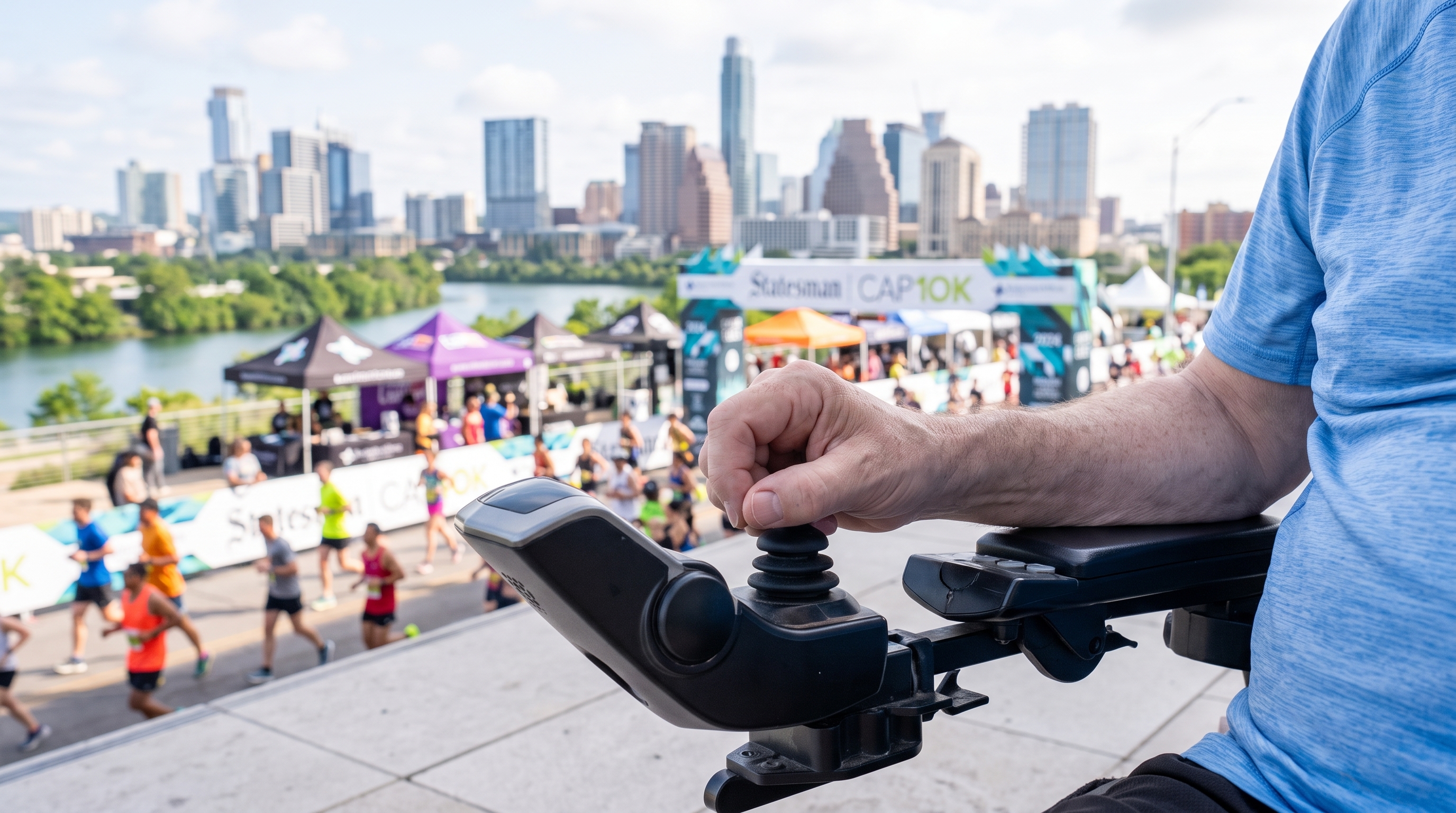
When most people think about race training, their minds immediately jump to legs: quad burnout, hamstring tightness, knee stabilization, and worn-down shoe treads.
I don’t walk anymore. And in this version of training, the legs are essentially along for the ride.
Re-architecting my workout around that reality threw out almost every conventional piece of running and endurance advice. It turns out that when your lower half is out of the propulsion equation, your entire kinetic chain gets radically simplified. And concentrated.
Here are five ways my training looks completely unusual now that legs don’t matter, and everything comes down to my seat and my right hand.
1. The Seat Is the Entire Foundation
In standard running, balance and posture originate from your feet contacting the ground. Here, my butt is the primary anchor point. Every ounce of leverage, balance, and directional stability relies on pelvic position and core engagement against the seat. If my seating angle is off by two degrees, power transfer evaporates, and fatigue sets in twice as fast. Training starts by dialing in the base before a single meter is logged.
2. My Right Hand Is the Engine
Without legs pushing off pavement, propulsion narrows down to targeted mechanics, and for me, the right hand does the heavy lifting. Training isn’t about bilateral symmetry anymore; it’s about precision, grip endurance, and repetitive torque from one limb. If my right wrist or forearm fatigues, the whole system grinds to a halt.
3. “Cardio” Originates from Much Smaller Muscle Groups
Elevating your heart rate using quads and glutes is relatively easy; they’re massive muscle engines demanding huge amounts of oxygen. Try hitting aerobic threshold zones relying strictly on upper-body exertion and concentrated drive mechanics. It requires sustained, relentless effort because smaller muscles fatigue faster, demanding far stricter pacing discipline.
4. Aerodynamics and Ergonomics Replace Stride Length
Runners obsess over cadence and stride length. My equivalent metric is mechanical efficiency: how cleanly force translates through my contact point without wasting energy on friction, awkward posture, or inefficient steering micro-corrections. Every movement has to be deliberate; sloppy mechanics can’t be masked by a quick burst of leg drive.
5. Recovery Focuses on Unorthodox Wear Points
Nobody is foam-rolling IT bands or icing shins here. Post-session recovery targets palm friction, shoulder stabilizer fatigue, lower-back tension from sustained seating pressure, and wrist tendon health. The muscle groups being rebuilt after a hard effort are entirely different from standard endurance athletes, but the discipline required to maintain them is identical.
Why the Miles Still Count
Adapting the mechanical problem doesn’t change the underlying purpose. The goal remains moving forward with purpose, putting in the work, and showing up for the community around us.
I’m training in support of Livestrong, helping ensure individuals facing life-altering health and mobility challenges get the practical resources, navigation, and support they need to keep moving.
If you’d like to back this effort and be part of the work, you can contribute here:
Support My Run for the Roses Campaign
Every donation directly powers their mission—and every mile logged proves that how you move matters a lot less than the fact that you keep going.
Leave a Reply